SERVICE / 04

Give security decisions an owner.

Senior security guidance for strategy, priorities, executive reporting, and control ownership without a full-time hire.

Ten contracted hours per month; additional work agreed in advance

Have a particular question about this work?

Explore a guide and refine the focus ↗

WHO IT IS FOR

For growing organizations that need consistent security leadership alongside an existing IT or engineering team.

As questions from customers, insurers, and leadership become more frequent, one-off projects no longer keep the whole program aligned.

THE WORK

From question to evidence.

  1. Establish the current risk picture and a practical roadmap.
  2. Set owners and decision points for the controls that matter.
  3. Translate security work into clear updates for leadership and stakeholders.
  4. Review progress and adjust priorities as the business changes.

WHAT YOU TAKE AWAY

A coherent security roadmap, accountable control owners, and a steady decision-making rhythm.

AN EXAMPLE OF THE OUTPUT

Explore the deliverable.

Compare engagements ↗

ILLUSTRATIVE SAMPLE / FICTIONAL ENGAGEMENT

Customer-review response

Turn a broad security claim into a supported answer.
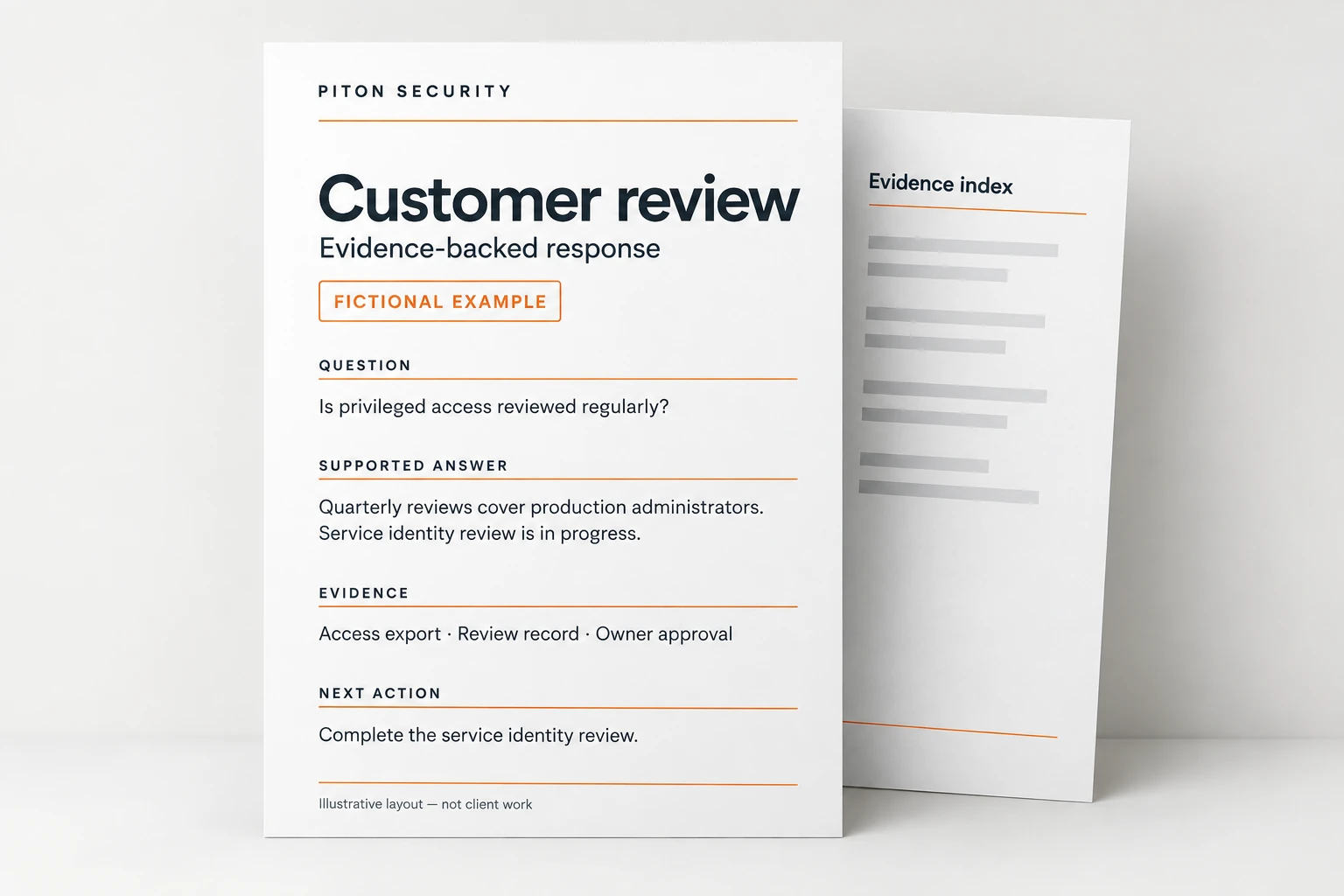
Fictional customer-review response document with supported answer, evidence, and next action.
Fictional document mockupView full size ↗
Question or test
Customer asks: “Is privileged production access reviewed regularly?”
Response or finding
Access reviews run quarterly. The latest review covered the production administrator group and recorded owner sign-off. Service identities are tracked separately; their review is still in progress.
Evidence and consequence
A dated access export, review record, approval, and removal ticket support the human-access claim. The service-identity gap is recorded rather than hidden.
Follow-up and reusable answer
Next action
Assign an owner to finish the service-identity review and agree on how to communicate that gap to the customer.
Reusable record
Keep the approved answer with its evidence date, scope, owner, and review date so the next response can be checked before reuse.
ILLUSTRATIVE SAMPLE / FICTIONAL ENGAGEMENT

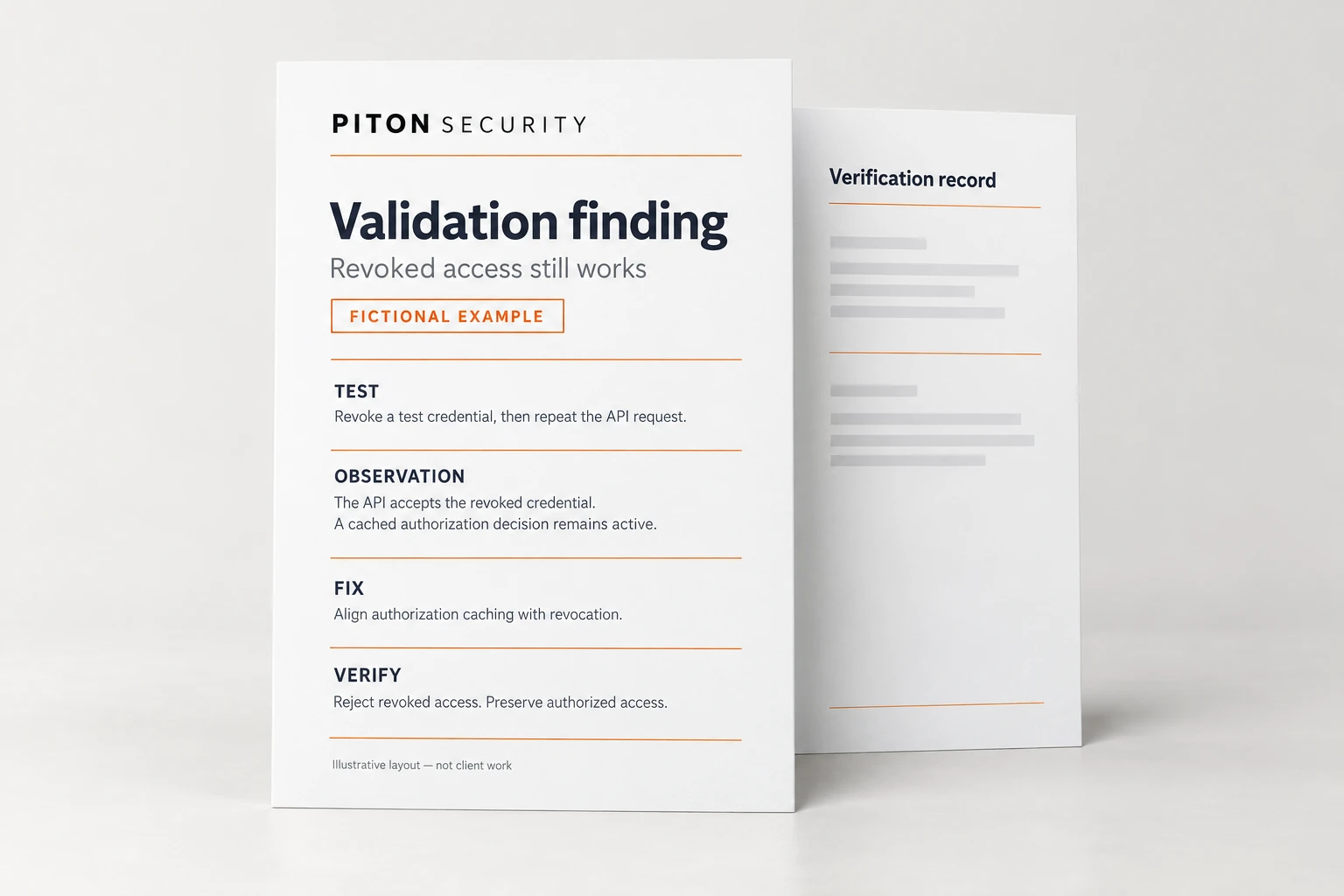
Validation finding

A revoked service credential still reaches a production API.

Fictional validation report with test, observation, fix, and verification sections.
Fictional document mockupView full size ↗
Question or test
Test: revoke a designated test credential, then repeat its previously permitted API request.
Response or finding
The identity service records the credential as revoked, but the API continues accepting it through a cached authorization result.
Evidence and consequence
The revocation timestamp and repeatable request/response show a gap between the identity state and the API’s enforcement. The report records the tested window and affected endpoint.
Fix and verification plan
Fix
Align API authorization and cache invalidation with credential revocation. Assign the change to the relevant application and identity owners.
Retest
Repeat the same revocation sequence and check the affected API. Confirm revoked access is rejected and an authorized credential still works.

ILLUSTRATIVE SAMPLE / FICTIONAL ENGAGEMENT

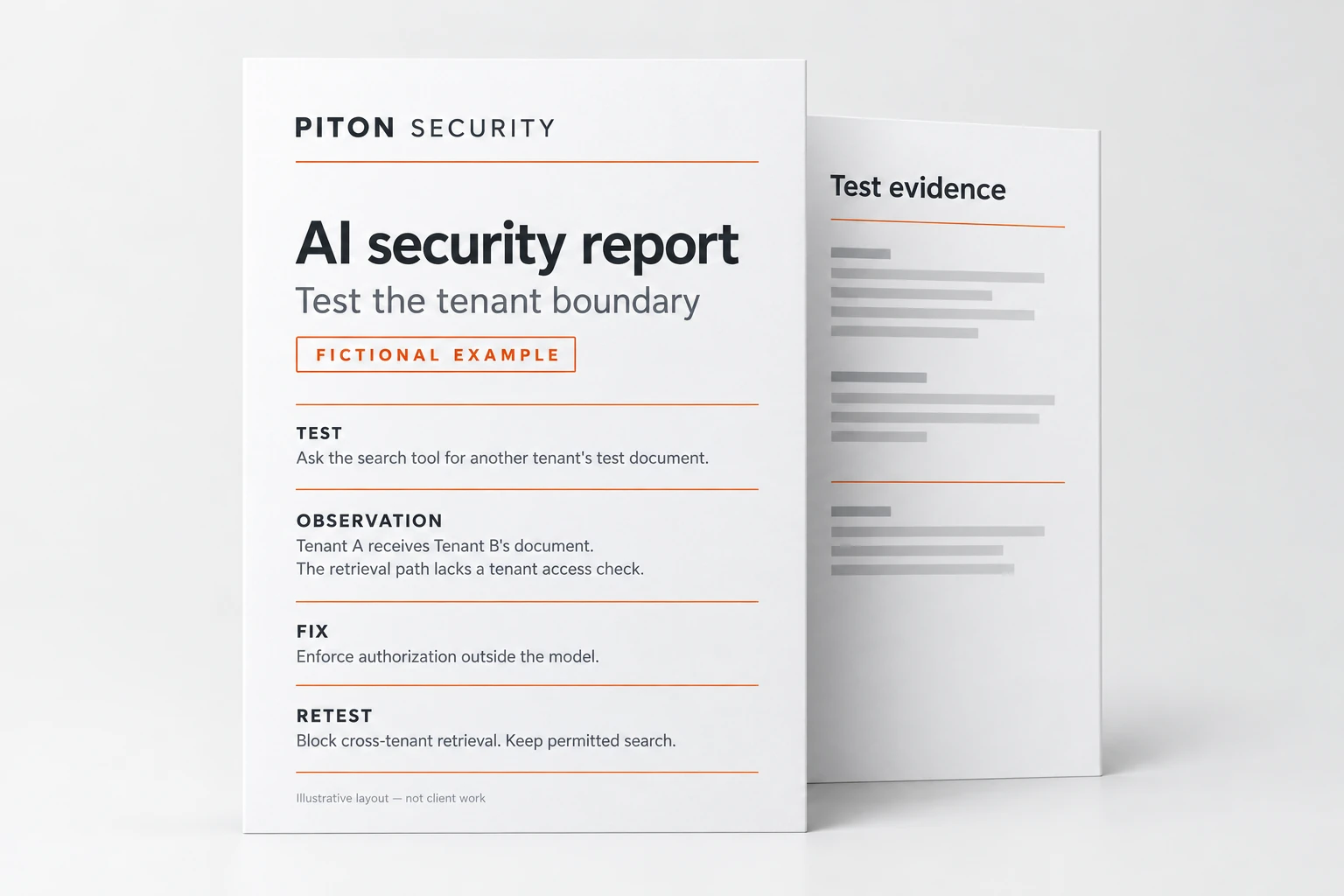
AI application test report

A support assistant returns another tenant’s document.

Fictional AI security report describing a cross-tenant retrieval test and retest.
Fictional document mockupView full size ↗
Question or test
Test: use an account in tenant A to request a test document belonging to tenant B through the assistant’s search tool.
Response or finding
The tool returns tenant B’s test document. The application checks login but does not enforce tenant access on the retrieved document.
Evidence and consequence
A signed-in customer could read another customer’s information through the support workflow. The finding records the test identities, retrieval path, and observed boundary failure.
Fix and verification plan
Fix
Enforce authorization on every tool request and returned document using the authenticated user and tenant. Keep that check outside the model.
Retest
Repeat the cross-tenant request with the original account and alternate inputs. Confirm unauthorized content is withheld and permitted searches still work.

ILLUSTRATIVE SAMPLE / FICTIONAL ENGAGEMENT

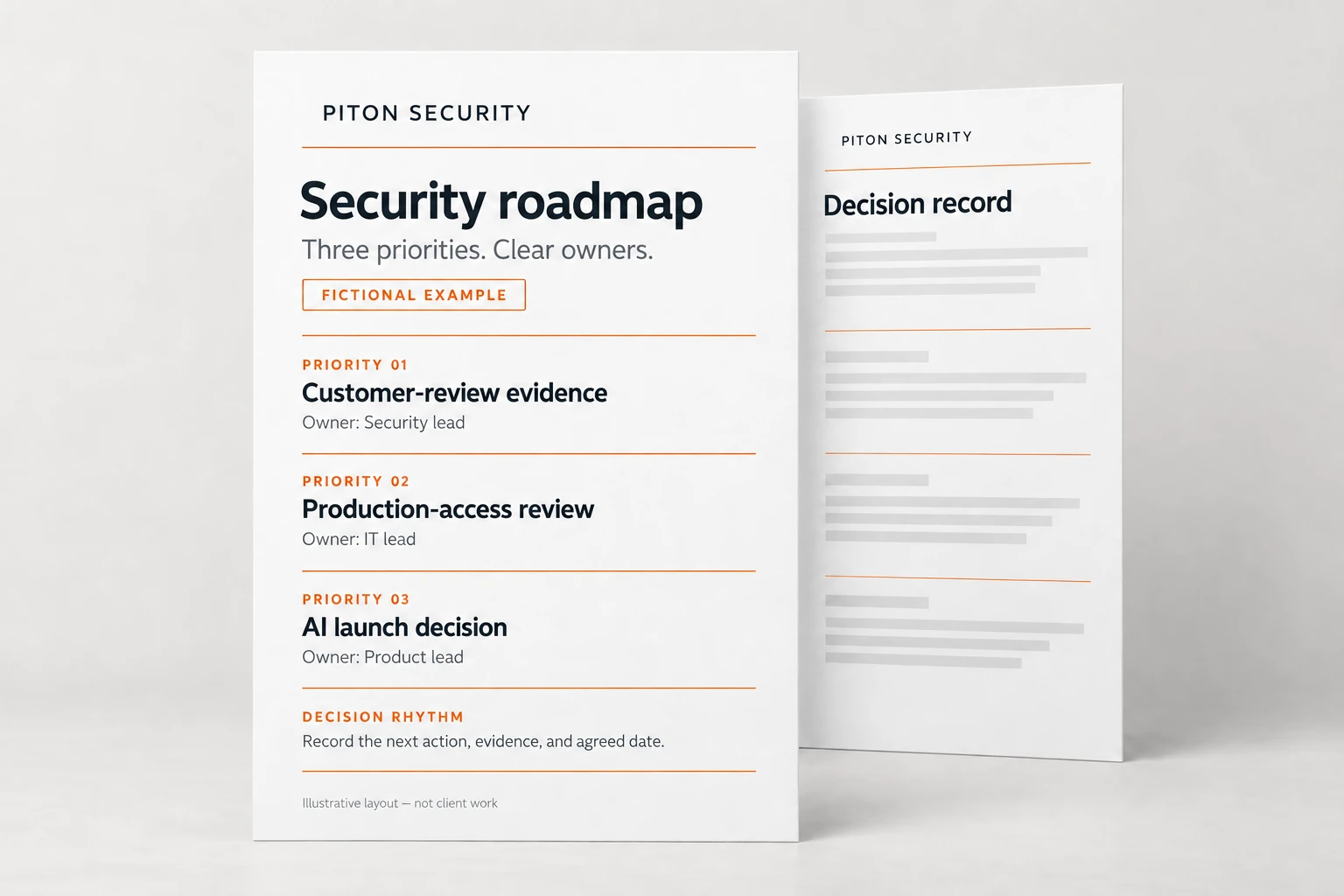
Leadership roadmap

Give the next quarter three owned security decisions.

Fictional security roadmap with three priorities and accountable owners.
Fictional document mockupView full size ↗
Question or test
Decision: prioritize customer-facing security commitments alongside a growing product team’s existing work.
Response or finding
Start with three priorities: ownership of customer-review evidence, the production-access review, and the AI launch decision. Record an accountable owner and the evidence each decision needs.
Evidence and consequence
The roadmap connects each priority to a business decision, a control owner, and a check-in date. Unresolved assumptions remain visible rather than being presented as completed work.
Ownership and decision rhythm
Action record
For each priority, record the owner, next action, evidence required, dependencies, and the decision date agreed with the team.
Leadership update
Use a regular review to show what changed, what remains blocked, and which decision needs leadership attention. Adjust priorities as the business changes.

PRACTICAL QUESTIONS

Before we begin.

Prepare a scope brief ↗
Does this replace our engineering or IT team?

The engagement provides consistent security guidance alongside the existing team. It focuses on priorities, ownership, executive reporting, and decisions.

How much time is included?

The service is ten contracted hours per month. Additional work is agreed in advance rather than assumed to be part of that allocation.

What do we receive?

A coherent security roadmap, accountable control owners, and a steady decision-making rhythm. The initial scope identifies the decisions and stakeholders that need that support.

What if we need a separate testing project?

Testing can be scoped as a focused engagement alongside leadership work. The boundaries, deliverables, and additional effort need their own agreement.

NEXT STEP

Talk through the scope.

Share the situation and the decision it needs to support.

Email Piton ↗

YOUR RECORD AND QUESTION COUNTS

Privacy preferences

Page adjustments are on by default unless your browser sends Global Privacy Control. Your saved starting point, answers, reading history, and inferred interests are kept in this tab’s browser session. Closing the tab ends the session; browser session restore may bring it back. Only the off preference is saved persistently. AI guides send the situation and follow-up choices you select to a server-side writer through OpenRouter. On the guide page you can also choose to include your top two topic interests and up to four saved answers. Page history, reading measurements, contact information and scope briefs are never included. With remembering off or Global Privacy Control enabled, guides use only explicit choices. Optional questions also contribute to combined counts, as explained below. Review, remove or clear saved items before sharing a device.

Click the Piton Security logo in the header to return home and clear this tab’s learning queue. Your remembering preference stays the same.

Question counts

Optional questions report totals for displays, answers, dismissals, and scroll-pasts. Piton stores totals by question and answer option, without visitor IDs or individual event histories. These totals are not sent to an AI provider. “Turn this off” and Global Privacy Control stop reports. Clearing this browser cannot undo a contribution already combined into a total.

Show the stored data